Getting Started
This guide takes you from an empty Confluence page to a small, useful landing page. You do not need design or development experience.
Before you begin
Section titled “Before you begin”You need:
- A Confluence Cloud site with Better Pages installed.
- An active Marketplace evaluation or subscription.
- Permission to create or edit a page.
- A Confluence administrator only if the app still needs to be installed or site-wide settings must be changed.
If the app is not installed, a Confluence administrator opens the Better Pages Marketplace listing, selects Try it free, chooses the destination site, and reviews Atlassian’s installation and permission screens. After installation, Better Pages appears in the Confluence macro browser and under Apps.
Find each Better Pages tool
Section titled “Find each Better Pages tool”| Location | What you can do there |
|---|---|
| Confluence page editor | Insert and configure the 19 reader-facing macros |
| Apps → Better Pages | Browse templates and start page-building journeys |
| Published page byline | Open Smart Designer for a reviewed page-level change |
| Apps → Better Pages Space Manager | Inventory pages and preview multi-page operations |
| Confluence administration | Manage Brand Kits, colors, templates, feature controls, external policy, and diagnostics |
Add a macro
Section titled “Add a macro”The same workflow applies to every Better Pages component:
- Open a Confluence page and select Edit.
- Put the cursor where the component should appear.
- Type
/better pages, or select Insert elements and search forBetter Pages. - Choose a macro, such as Better Pages Alert.
- Configure the component and review its preview.
- Select Save in the macro configuration.
- Publish or update the Confluence page.
- Test the published interaction as a reader.
If a macro contains rich Confluence content, select its body on the page and edit that content with the normal Confluence editor.
Build a starter landing page
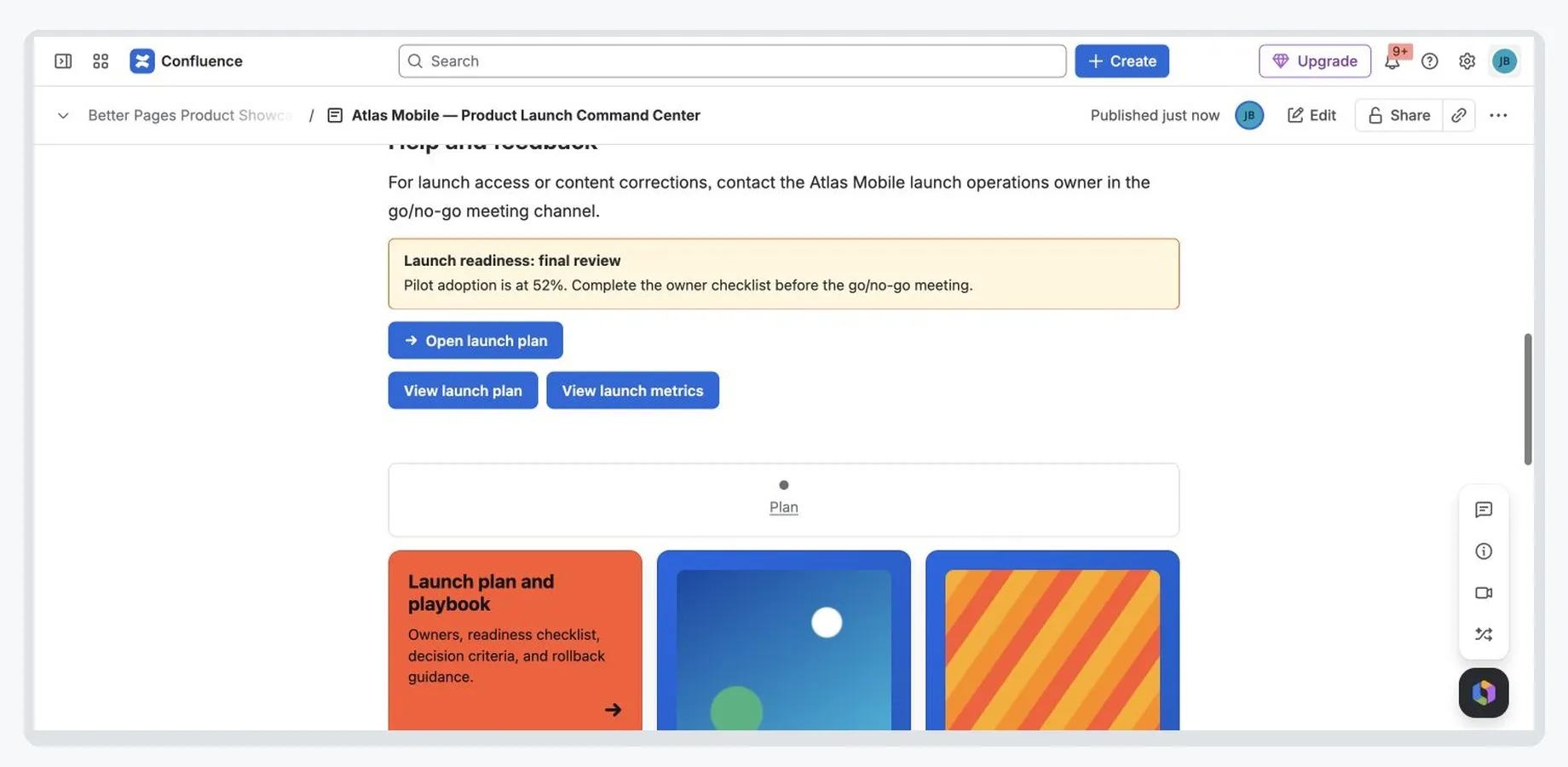
Section titled “Build a starter landing page”Use the following four components to create a compact project or team landing page.
1. Lead with an Alert
Section titled “1. Lead with an Alert”Insert Better Pages Alert and choose Message panel for information that should remain in the page flow. Add a short title and one actionable sentence.
Example:
Release readiness review
Confirm owners and open risks before Friday at 15:00.
See the Alert guide for page-load alerts, images, colors, and dismissal behavior.
2. Add the main destinations
Section titled “2. Add the main destinations”Insert Better Pages Advanced Cards. Create one card for each important destination, such as the product plan, release checklist, support guide, and team directory. Use short descriptions so readers can choose without opening every link.
See the Advanced Cards guide for images, layout, color, reordering, and destinations.
3. Organize the details
Section titled “3. Organize the details”Insert one Better Pages Tabs macro and create three tabs such as Overview, Readiness, and Decisions in its group editor. After saving the macro, put the detailed Confluence content inside the matching heading section in the macro body.
See the Tabs guide for styling, default tabs, shareable tab links, and keyboard behavior.
4. End with one clear action
Section titled “4. End with one clear action”Insert Better Pages Button. Link it to the next action readers should take, for example Open the release checklist. Choose a filled style for the primary action and keep the label specific.
See the Button guide for page search, safe destinations, icons, colors, sizes, and new-tab behavior.
Preview, publish, and verify
Section titled “Preview, publish, and verify”Before publishing, check that:
- Every title and link is meaningful without surrounding explanation.
- Images have useful alternative text, or are clearly decorative.
- Colors have enough contrast in both light and dark Confluence themes.
- The page has one obvious primary action rather than several competing ones.
After publishing, click every action and test Tabs, Alerts, and Cards with both pointer and keyboard controls. Also narrow the browser window to confirm the layout remains readable.
Supported destinations
Section titled “Supported destinations”Buttons and linked components accept:
- A Confluence page selected with the built-in page search.
- A relative Confluence path beginning with
/. - A page anchor beginning with
#. - An
https://web address without embedded credentials. - A valid
mailto:email address.
Unsafe or unsupported destinations such as javascript:, file:, malformed
email links, and protocol-relative URLs are rejected. The component remains on
the page but its navigation action is not enabled until the destination is
fixed.
Where to go next
Section titled “Where to go next”Use the macro catalog to find the best component for your next page. Continue with Templates and Better Pages Home for complete page starters. Site administrators can configure shared colors, Brand Kits, feature controls, and other site-wide behavior in Better Pages administration.