Getting Started
This guide takes you from installation to the first issue hierarchy created from a reusable template. You do not need to understand Forge or edit JSON.
Before you begin
Section titled “Before you begin”You need:
- A Jira Cloud site with the app installed and an active evaluation or subscription.
- Permission to create issues in the target project.
- A Jira or project administrator to install starters or manage governed templates.
Open the template library
Section titled “Open the template library”- In Jira, open Apps.
- Select Issue Templates & Hierarchy Builder.
- Enter an issue key from the project you want to use for the starter data.
- Select Install editable starter templates.
The starter gallery contains normal editable templates for a bug report, user story, teammate onboarding, and release readiness. They are starting points, not locked demo content.
Review a template
Section titled “Review a template”Open Release readiness and select Edit. Review:
- The Jira project and root issue type.
- Root fields owned by the template.
- The three child tasks and their parent relationships.
- Any variables that users answer for each run, plus supported Smart Values
such as
{{today+7d}}or{{project.key}}. - Availability rules and default behavior.
Save only when the project, issue type, and fields match your Jira configuration. See Templates and supported fields for the complete field list.
Preview and create
Section titled “Preview and create”- Select Preview create on the template.
- Answer any required variables.
- Review the resolved root fields, especially dates and Jira-context values.
- Change a run-specific value if needed.
- Deselect any child work that is not required this time.
- Select the final Create action.
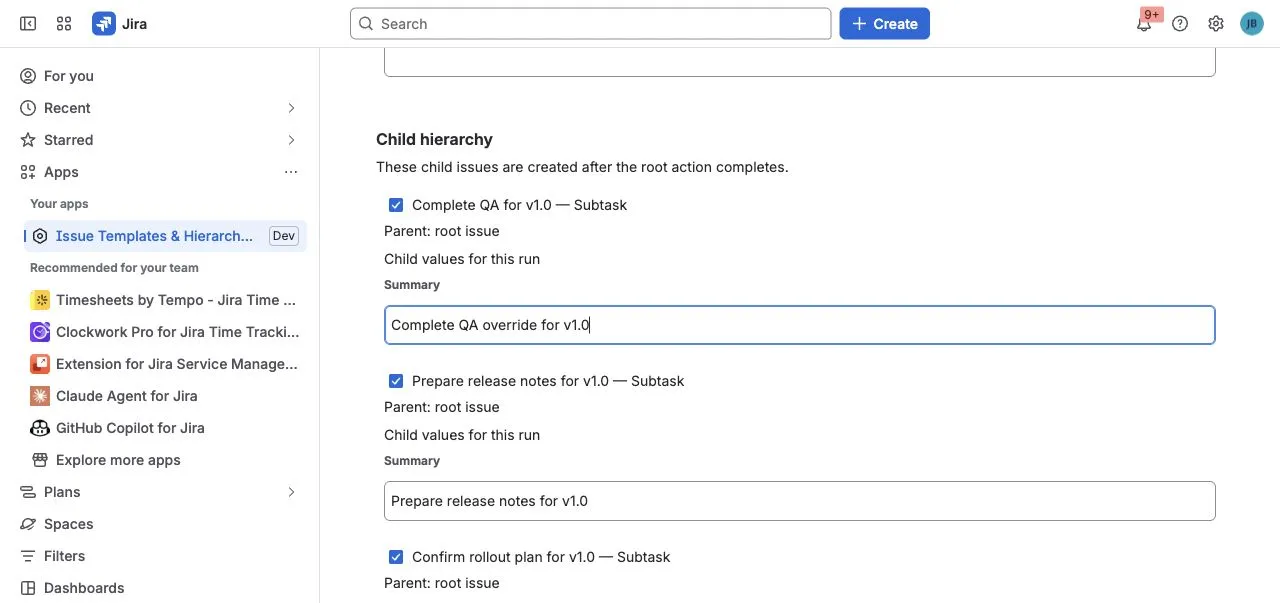
The root issue is created first. Child work is then processed from a durable run plan. If a child fails, completed items are retained and a retry does not create them again.
Variables are questions answered by the user. Smart Values are bounded values resolved by the app from the run time or Jira context. They are not the Jira Automation expression language. See Variables and Smart Values for the exact token list and availability rules.
Confirm the result
Section titled “Confirm the result”Open the new root issue and check:
- The expected fields and subtasks are visible in Jira.
- Template details shows the template name and revision.
- The run status is completed, or each partial result explains what needs attention.
Next, learn how to Apply or Recreate work and how to configure availability.