Templates and Supported Fields
A template describes one root issue and an optional bounded hierarchy of subtasks or linked issues. It also records the Jira context, variables, availability rules, overwrite policy, and revision used for support and provenance.
Create a template from scratch
Section titled “Create a template from scratch”- Open the template library and select Create template.
- Give the template a clear name, description, and category.
- Choose the target Jira project and issue type.
- Load the Jira fields available in that context.
- Select only the fields the template should own and enter their values.
- Add child definitions and load fields separately for each child issue type.
- Add variables or availability rules when needed.
- Save the template.
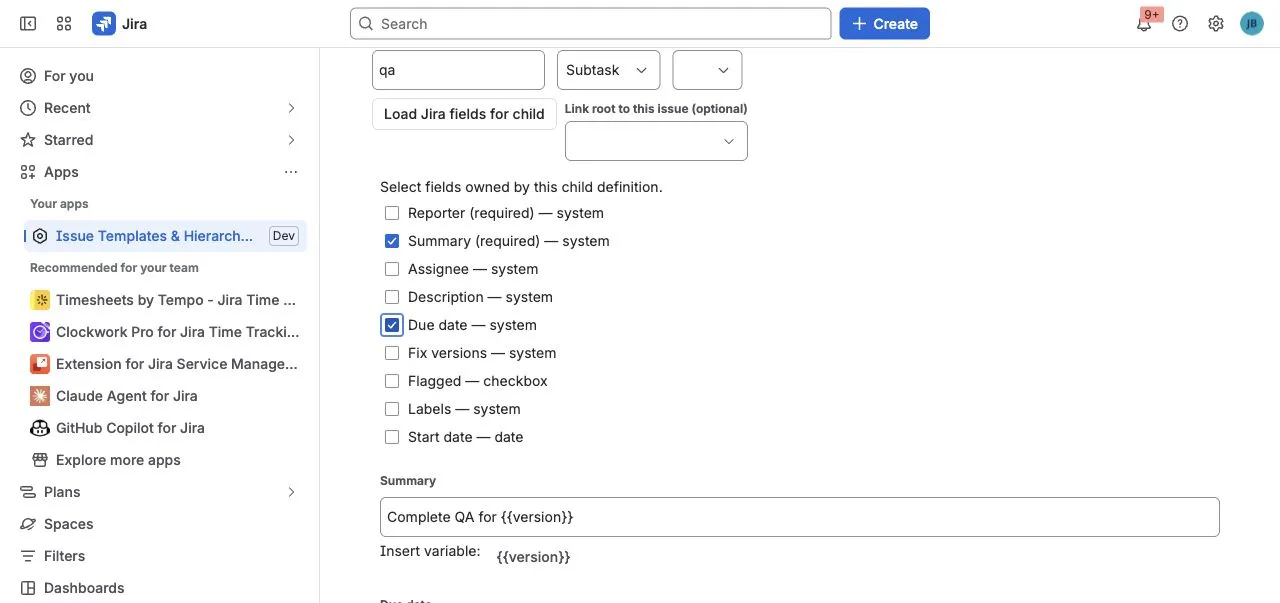
The app stores stable Jira field IDs and compact schema information. Field names remain readable labels and can change without becoming the field’s identity.
Add reusable and dynamic values
Section titled “Add reusable and dynamic values”Use the Insert variable controls beside compatible root and child text
values to add tokens such as {{version}}. Date fields also provide shortcuts
for Today, In 7 days, and In 1 month.
Typed Jira fields should normally keep their typed editor. For example, choose a user with Jira’s User picker and choose a Sprint from the discovered Sprint options. Do not place a text token into a Jira option ID unless that exact path has been verified in Preview.
Read Variables and Smart Values before using
context tokens such as {{issue.key}} or {{parent.key}}; some Jira values do
not exist until a particular operation or child creation step.
Capture an existing issue
Section titled “Capture an existing issue”Use Create template from issue when a live issue already represents the process you want to reuse.
The capture preview lists supported root fields and native subtasks. Choose the fields and child work to keep before saving. Unsupported fields are reported and omitted rather than copied with a guessed payload.
Supported Jira-native fields
Section titled “Supported Jira-native fields”The documented product paths support:
- Short text and paragraph fields.
- URL and number fields.
- Date and date-time fields.
- Single select, multi-select, cascading select, and checkbox fields.
- Single-user and multi-user pickers.
- Group and multi-group pickers.
- Sprint fields on supported Jira Software contexts.
- Common system fields such as Summary, Description, Assignee, Reporter, Priority, Labels, Components, Fix versions, Due date, and Environment when Jira exposes them as writable in the selected context.
For Sprint, the app discovers active and future Sprints from visible Scrum boards. Jira rejects a direct Sprint assignment to a subtask, so subtasks inherit Sprint membership from their parent instead.
Context changes
Section titled “Context changes”A field can be removed, renamed, or leave the target project/issue-type context. Before writing, the app reloads the live Jira metadata. An unavailable field is warned and skipped; it does not silently invalidate the whole hierarchy.
See Known limitations for Rank, Assets, third-party fields, and native Create-specific boundaries.